Janice Williamson writes Dear Brigette DePape (a message from Nellie McLung)

STOP HARPER!

Never retract, never explain, never apologize –

get the thing done and let them howl!

Nellie McLung, 1915
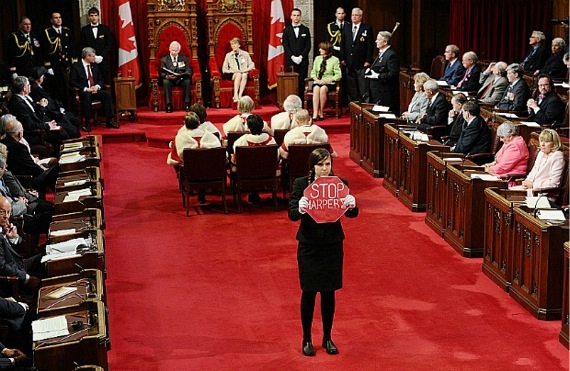
Brigette DePape recently graduated from her studies in international development and globalization at the University of Ottawa. She is also a young performance artist.  On Friday June 3, she demonstrated the fine art of nonviolent civil disobedience during the reading of the speech from the throne in the Canadian Senate. She had a press release ready when she was escorted from the Senate. In her interviews, she demonstrated how to stay on message:

Harper’s agenda is disastrous for this country and for my generation. …We have to stop him from wasting billions on fighter jets, military bases, and corporate tax cuts while cutting social programs and destroying the climate. Most people in this country know what we need are green jobs, better medicare, and a healthy environment for future generations.

Contrary to Harper’s rhetoric, Conservative values are not in fact Canadian values. How could they be when 3 out of 4 eligible voters didn’t even give their support to the Conservatives? But we will only be able to stop Harper’s agenda if people of all ages and from all walks of life engage in creative actions and civil disobedience. …This country needs a Canadian version of an Arab Spring, a flowering of popular movements that demonstrate that real power to change things lies not with Harper but in the hands of the people, when we act together in our streets, neighbourhoods and workplaces.

Continue reading “Janice Williamson writes Dear Brigette DePape (a message from Nellie McLung)”

Scrupling Canadian women’s nonfiction writing

to scruple

In a CBC-Radio interview on The Current, the distinguished Canadian peace activist and scientist Ursula Franklin introduced me to the Quaker tradition of “scrupling.” In response to my interest, Ursula Franklin emailed me in November 2010: “delighted that you understand my reasoning to revive the old notion of “scrupling” as an activity and the use of scrupling as a verb. Today we google. High time – I say- to scruple also.”

“To scruple” means “to hesitate as a result of conscience or principle.” This hesitation, a pause to reflect, is a move that invites a critical distance, a useful antidote to the status quo. The etymological root of “scruple” is —

from O.Fr. scrupule (14c.), from L. scrupulus “uneasiness, anxiety, pricking of conscience,” lit. “small sharp stone,” dim. of scrupus “sharp stone or pebble,” used figuratively by Cicero for a cause of uneasiness or anxiety, probably from the notion of having a pebble in one’s shoe. The verb meaning “to have or make scruples” is attested from 1620s.

Canadian women nonfiction writers need  a “small sharp stone” to prick at the conscience of editors, publishers, literary prize jurors and reviewers. To think about the context in which Canadian women’s nonfiction is produced, is to suddenly feel a pebble in one’s shoe, an irritation that irks.

We also need to prick at the psyches of those who minimize the value of writing, education, the arts, and critical thinking. Our ability to communicate ideas and insight to others makes us natural candidates for engagement in public discussion and debate. We need spaces to share information, to publish reviews and observations about writing and life, to invite writers to investigate the politics and poetics of our cultural life and our everyday.

Wouldn’t it be wonderful to locate a digital meeting place of writers and readers, an archive of work, a space for reviews and reflections. What would it look like? What would it do? How might it help us innovate in our own writing, share the insights of others, provide us with information about how to break down and through institutional barriers? How might it influence and inform? How might a collective writing space explore and undo limiting attitudes, even those that remain unspoken.  How could we make common cause to ensure that ethnocentrism and racism don’t remain the unarticulated status quo of the way things tend to work in our world? Continue reading “Scrupling Canadian women’s nonfiction writing”

Vida on women’s writing in “The Best American Count” …

Our most recent count examines the contents of the Best American anthologies in poetry, fiction, and essays. When we released our 2010 Count back in February, a common response from our readers was a request for more information about the data behind our pie charts. With that in mind, we have expanded our presentation to include the tables shown below, which are based on the spreadsheets we use to generate our Count pie charts. We think these tables better represent the data, and reveal more of the complex set of questions and issues raised by it.
In the Best American Essays Series from 1986 through 2010, the numbers look dire across the board. Works by women accounted for only 29% of those published in the anthology. There was only one year in twenty-five that the number of works by women published in the anthology outnumbered the works by men.

Susan Olding takes the Kingston Do the Math Challenge


Susan Olding participated in the Kingston “Do the Math Challenge”
that was organized by The Food Providers Networking Group and Kingston Community Roundtable on Poverty Reduction.  You can read her journal about how she tried (and failed) “to survive for a week on a food bank diet in support of the Put Food in the Budget Campaign to raise awareness of poverty and hunger in Kingston.”
The organizers describe how “participants accepted the Challenge in solidarity with people receiving social assistance and to draw attention to their inadequate incomes. They wanted to find out for themselves whether anyone anywhere in Ontario earning a total of $592 per month could possibly afford housing, food, transportation, and everything else. Food banks were never meant to be a permanent part of Ontario’s safety net, and those who volunteer and staff food banks agree that in spite of their best efforts the amount of food they make available to clients is inadequate.

You can follow Susan’s reflections in her blog journal account of the experience. Continue reading “Susan Olding takes the Kingston Do the Math Challenge”

Fiona Tinwei Lam – commentary “Mother’s Day’s Radical Roots”

excerpt      …No mother is a cliché

For many reasons, it might have been easier for me to celebrate a commemoration of women’s pacifism and civic contributions while I was growing up. When I was in my teens and 20s, I found Mother’s Day particularly difficult. The social expectations around the holiday seemed to revolve around honouring a type of Leave it to Beaver domestic goddess. I could never find a card that could even start to describe the complex feelings I had about my complex mother. We had a challenging relationship. Even though I deeply respected and admired her devotion to medicine, her hard work and many talents in making music and art, I mostly tried to stay out of her way, leery of her sudden rages and tirades. Even back then, I realized she was parenting as best as she could with no parenting role models herself. During her childhood, her own mother had disliked her for being a daughter and had little to do with her upbringing. And my maternal grandmother in turn had been sold as a young girl by my great-grandmother, her mother. My class-conscious paternal grandmother was distant and disapproving.

As a result, I grew up somewhat alienated from the inherent glorification and idealization of motherhood embodied in Mother’s Day, forced to profess sentiments I didn’t necessarily feel, while being riddled with guilt for not feeling them.

When I became a mother myself, I questioned gender stereotypes and the unequal division of domestic duties the same way my own mother did, but gained a deeper understanding of the significance, challenges and pleasures of parenthood from the years of sleepless nights to the delights of receiving another bouquet of freshly plucked dandelions. Perhaps Anna Jarvis was right that greeting cards could never suffice: no parent can be reduced to a few cliché-ridden stanzas in a store-bought card….

via The Tyee – Mother’s Day’s Radical Roots.

Fiona Tinwei Lam – commentary “The Hole in the Middle: Gambling, Families and Politicians”

excerpt    …Premier Christy Clark recently announced that over 2,000 B.C. non-profits would receive an immediate $15 million in community gaming grants. “We’re putting families first by providing more funding for programs that support healthier children, stronger families and more vibrant communities,” she stated in a news release. A quarter of the 2,000 charities will be restored to prior funding levels, after having had their budgets slashed when the province drastically reduced gambling grants to non-profits from $156 million in 2008-2009 to $112 million in 2009-2010.

But just like that casino’s deck of cancelled cards, the positive announcement seemed to have a gaping hole in the middle: the knowledge that a significant proportion of those grants geared to benefit individuals and families in our community originates in the desperation, misery and impoverishment of others. This key time leading up to the provincial election offers voters an excellent opportunity to question our incumbent and prospective political representatives on this issue to determine whether they have the courage to take a stand. [Tyee]

via The Tyee – The Hole in the Middle: Gambling, Families and Politicians.

Rachel Giese writes on Canadian myths about crime & immigration

Rachel Giese 

writes in The Walrus June 2011

“Arrival of the Fittest”

Canada’s crime rate is dropping as immigration increases. Is there a connection?

Late last summer, the MV Sun Sea, a small Thai cargo ship, entered Canadian waters off the British Columbia coast, where it was intercepted by the navy and the RCMP. Crowded on board were 492 Tamils, including women and children. The vessel’s arrival was not unexpected; in fact, the government had been monitoring its journey for months and had intelligence that it was smuggling refugees from Sri Lanka. Canada has been a popular destination for people fleeing the ravages of the twenty-six-year civil war and a 2004 tsunami: there are now 20,000 Sri Lankans here, and more coming all the time.

A few days before the Sun Sea reached the coast, public safety minister Vic Toews was in Toronto giving a luncheon speech on national security to the Economic Club of Canada and announced, “I can assure you that we are concerned about who is on that ship and why they might be coming to Canada.” He was referring to the Liberation Tigers of Tamil Eelam, known as the Tamil Tigers, which has been banned in Canada as a terrorist organization. The previous year, when a rusty ship called the Ocean Lady carrying seventy-six Tamil men arrived off the coast of Vancouver Island, the government arrested the passengers and held them for months, alleging that a third of them were Tamil Tigers sent to infiltrate Canada and set up operations here. (No evidence was ever found to support that claim, and they’ve since been released. All are pursuing refugee claims.)

That the point person was Toews, and not Jason Kenney, the minister of citizenship, immigration, and multiculturalism, was telling. It framed the Sun Sea situation as a potential danger to the public, and prompted a swift response. The passengers were put into detention (nearly sixty of them remain there, and in March two were ordered to be deported because of ties to the Tigers). The government also introduced Bill C-49, which would allow officials to detain smuggled migrants for one year, and bar them from applying for permanent residence and sponsoring family members for five years.

The public was unsympathetic…

Read the rest of the article at The Walrus

For an audio interview with Rachel Giese about this essay, see:

writing the i in oil

the pomegranate Writes the “I” in Oil

Why “oil”?

This site and blog are based in Edmonton, Alberta, Canada, where the economy pivots on oil. I encourage contributors to reflect on the oil economy. How does it impact your everyday life? How do you think through sustainability in an oil economy?

This category “oil” slides into issues around the environment. But to write “oil” is to think about how we live and work. Who profits? How is our economy tied to it whether we live and work in Fort McMurray’s Tar Sands  or bicycle to work in Vancouver. Oil is what we take for granted. How does oil impact our lives? How we are implicated in it?  How do our workplaces benefit from it? The oil industry contributes millions to the workplace that puts a roof over my head.

How do we write ourselves in the oil economy. What is accomplished when bring this network of connections into the light?

How might things might be different? Continue reading “writing the i in oil”