Heather Mallick: Meet the woman who counsels torture victims

The Toronto Star Heather Mallick: Meet the woman who counsels torture victims.

…In the course of her intensely lived life, Bamber, who helped found Amnesty International, once put a torture hood on her head to describe to a court what it feels like — the suffocation, the gagging and the panic in the dark — and has spent decades counselling people who will never recover from the bodily and mental insult.

You don’t get better after torture. It is the most isolating experience possible, and this is what the torturers intend. Every day, Bamber dresses with precision and elegance — it’s a form of armour, she agrees — and goes to her London office to sit with and listen to people who endured it.

Bamber campaigned for codifying medical ethics in Britain, helped build the now-thriving Medical Foundation for the Care of Victims of Torture and now operates her own Helen Bamber Foundation, offering clinical help. The waiting room is worrying, with people who look simultaneously dead tired and alarmed. They are very, very thin.

What I’m trying to find out from Bamber is where she gets her strength. How do you see the worst that humans can do and then confront it over and over again in a lifetime?…

Heather Robertson wins Graeme Gibson Award

The Writers’ Union of Canada announces –

“Canadian nonfiction writer Heather Robertson was presented with the Graeme Gibson Award by The Writers’ Union of Canada at its Annual General Meeting on May 28, 2011. Established by the Union in 1991 for “varied and remarkable contributions to improve the circumstances of writers in Canada,” the award has been given to Graeme Gibson and, in 1992, Pierre Berton. Ms. Robertson is its third recipient.

In 1996 a class action was launched against the Thomson Corporation and others by freelancers whose articles written for The Globe and Mail and other print publications were used in online databases without their authorization and without payment. Heather Robertson agreed to serve as the representative plaintiff. In 2009, thirteen years later and three years after a favourable decision from the Supreme Court of Canada on the main issue – whether freelancers’ consent was required to reproduce their articles in electronic databases – an $11 million settlement was reached in Robertson v. Thomson and payment made to the freelancers whose works were used without permission. Ms. Robertson brought a second class action against The Toronto Star, Rogers Publishing, CANWEST and others, again acting as the representative for the class of freelancers. A $7.9 million settlement in that case, nicknamedRobertson 2, was approved by the Ontario Court on May 3, 2011.

“We celebrate Heather Robertson for her courage and persistence in standing up for our rights and principles, quietly, unshakably, for so many years, when new technologies seemed about to sweep our rights away,” said Alan Cumyn, Writers’ Union chair. Heather’s tenacity will continue to inspire writers in our on-going fight to be paid fairly for digital uses of our work.”

“This has been very much a collective effort,” she said in accepting the award. “I could not have carried on without the moral and financial support of The Writers’ Union, the Professional Writers Association of Canada, and many individual writers from coast to coast.”

Heather Robertson was a founding member of The Writers’ Union of Canada and the Professional Writers Association of Canada.  She is a journalist, novelist and nonfiction writer whose books include Reservations are for Indians, Willie, A Romance, which won the Books in Canada First Novel Award and Walking into Wilderness, which won the Ontario Historical Society’s 2011 Fred Landon Prize for regional history. Throughout her writing career, Heather has been a prolific freelancer for national magazines such as Maclean’s, Chatelaine, Saturday Night, and Canadian Forum.

The Writers’ Union of Canada is our country’s national organization representing professional authors of books. Founded in 1973, the Union is dedicated to fostering writing in Canada, and promoting the rights, freedoms, and economic well-being of all writers.”


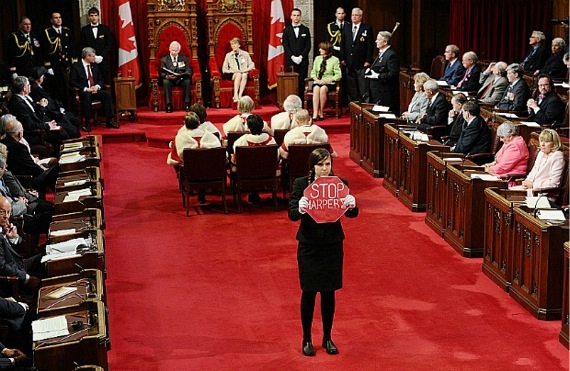
Janice Williamson writes Dear Brigette DePape (a message from Nellie McLung)

STOP HARPER!

Never retract, never explain, never apologize –

get the thing done and let them howl!

Nellie McLung, 1915

Brigette DePape recently graduated from her studies in international development and globalization at the University of Ottawa. She is also a young performance artist.  On Friday June 3, she demonstrated the fine art of nonviolent civil disobedience during the reading of the speech from the throne in the Canadian Senate. She had a press release ready when she was escorted from the Senate. In her interviews, she demonstrated how to stay on message:

Harper’s agenda is disastrous for this country and for my generation. …We have to stop him from wasting billions on fighter jets, military bases, and corporate tax cuts while cutting social programs and destroying the climate. Most people in this country know what we need are green jobs, better medicare, and a healthy environment for future generations.

Contrary to Harper’s rhetoric, Conservative values are not in fact Canadian values. How could they be when 3 out of 4 eligible voters didn’t even give their support to the Conservatives? But we will only be able to stop Harper’s agenda if people of all ages and from all walks of life engage in creative actions and civil disobedience. …This country needs a Canadian version of an Arab Spring, a flowering of popular movements that demonstrate that real power to change things lies not with Harper but in the hands of the people, when we act together in our streets, neighbourhoods and workplaces.

Continue reading “Janice Williamson writes Dear Brigette DePape (a message from Nellie McLung)”

Scrupling Canadian women’s nonfiction writing

to scruple

In a CBC-Radio interview on The Current, the distinguished Canadian peace activist and scientist Ursula Franklin introduced me to the Quaker tradition of “scrupling.” In response to my interest, Ursula Franklin emailed me in November 2010: “delighted that you understand my reasoning to revive the old notion of “scrupling” as an activity and the use of scrupling as a verb. Today we google. High time – I say- to scruple also.”

“To scruple” means “to hesitate as a result of conscience or principle.” This hesitation, a pause to reflect, is a move that invites a critical distance, a useful antidote to the status quo. The etymological root of “scruple” is —

from O.Fr. scrupule (14c.), from L. scrupulus “uneasiness, anxiety, pricking of conscience,” lit. “small sharp stone,” dim. of scrupus “sharp stone or pebble,” used figuratively by Cicero for a cause of uneasiness or anxiety, probably from the notion of having a pebble in one’s shoe. The verb meaning “to have or make scruples” is attested from 1620s.

Canadian women nonfiction writers need  a “small sharp stone” to prick at the conscience of editors, publishers, literary prize jurors and reviewers. To think about the context in which Canadian women’s nonfiction is produced, is to suddenly feel a pebble in one’s shoe, an irritation that irks.

We also need to prick at the psyches of those who minimize the value of writing, education, the arts, and critical thinking. Our ability to communicate ideas and insight to others makes us natural candidates for engagement in public discussion and debate. We need spaces to share information, to publish reviews and observations about writing and life, to invite writers to investigate the politics and poetics of our cultural life and our everyday.

Wouldn’t it be wonderful to locate a digital meeting place of writers and readers, an archive of work, a space for reviews and reflections. What would it look like? What would it do? How might it help us innovate in our own writing, share the insights of others, provide us with information about how to break down and through institutional barriers? How might it influence and inform? How might a collective writing space explore and undo limiting attitudes, even those that remain unspoken.  How could we make common cause to ensure that ethnocentrism and racism don’t remain the unarticulated status quo of the way things tend to work in our world? Continue reading “Scrupling Canadian women’s nonfiction writing”

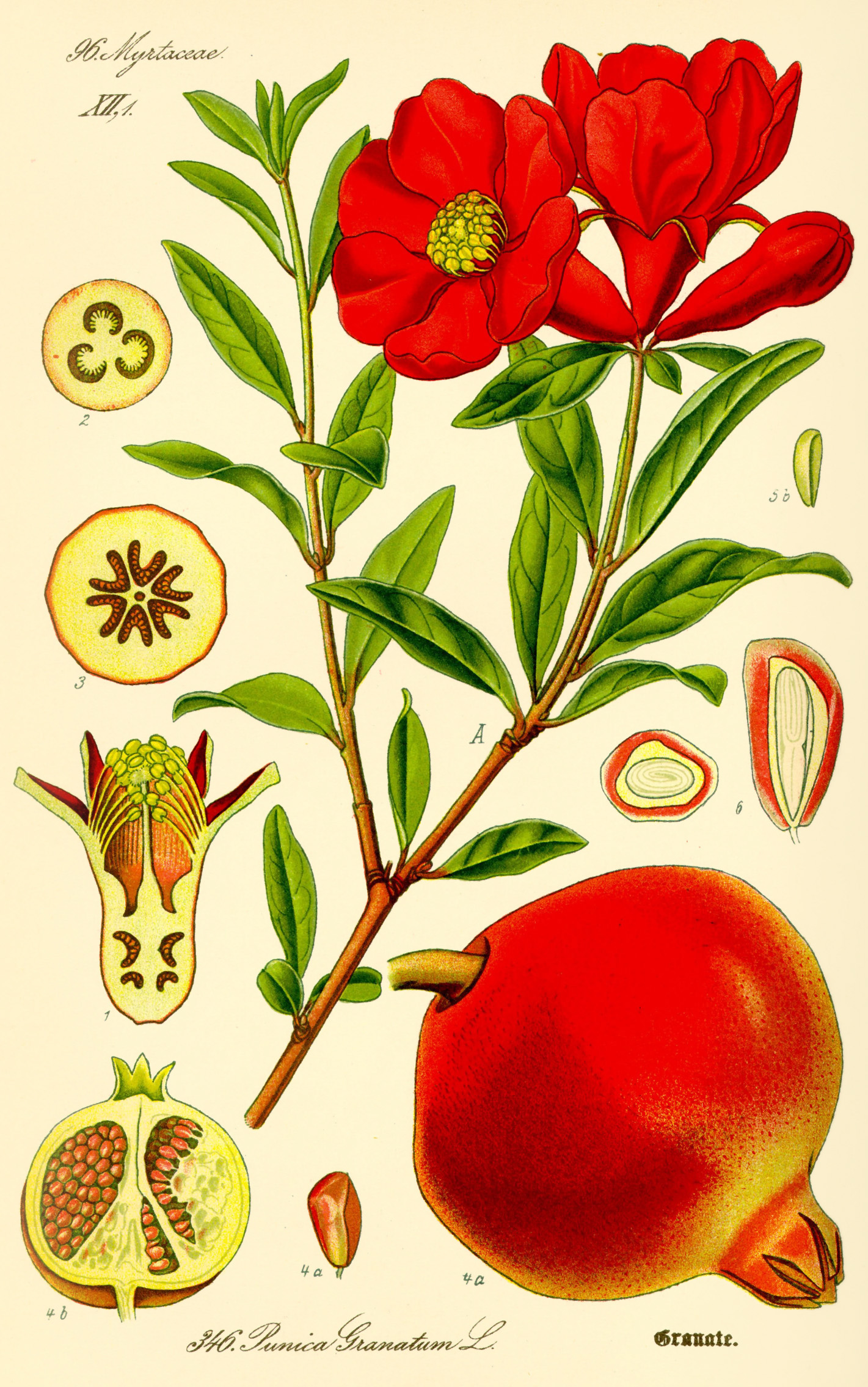
the pomegranate: a story

Why the pomegranate, strange fruit?

Why the glistening luminescent pomegranate red seeds? Why the three-chambered pomegranate that morphs through time and space?

In Persia, it means fecundity.

In Greece, the fruit is smashed on special occasions.

In Ovid’s Metamorphoses, the myth of Demeter and Persephone pivots on the seven pomegranate seeds that bind the kidnapped daughter to Hades’ underworld for six months of the year.

For poet Evan Boland, the myth of “The Pomegranate” mutates through time as the reader enters the words as daughter, then mother, or — not mother.

The only legend I have ever loved is
the story of a daughter lost in hell.
And found and rescued there.
Love and blackmail are the gist of it.
Ceres and Persephone the names.
And the best thing about the legend is
I can enter it anywhere.  And have.

The poet ends the poem muses on the inevitable separation from the maturing daughter and reflects

If I defer the grief I will diminish the gift.
The legend will be hers as well as mine.
She will enter it.  As I have.
She will wake up.  She will hold
the papery flushed skin in her hand.
And to her lips.  I will say nothing.

***

I first encountered Persephone in Ovid’s Metamorphosis, a book I read in a Greek mythology class with Jay Macpherson, Governor-General Award-winning poet and specialist in Romantic literature and classical mythology. The other half of the class featured the renowned critic Northrop Frye teaching about The Bible, a series of lectures that would become The Great Code.

In a small gallery across from the AGO in Toronto,  I found a small engraving of a girl asleep in an underground cave and she became an image I carried with me, a reminder of what it takes to come up from under in order to make your voice heard.

I write this four decades later from another place. In Ovid’s story, Demeter’s grief-stricken journey to search for her daughter Persephone is interrupted by an encounter with an older woman named Baubo. Without introduction, Baubo lifts up her skirts and laughs out loud. Demeter laughs too.

At twenty or so years of age, I didn’t get the joke. At almost sixty I clown along with Baubo’s  laughter, taking pleasure in her ribald buffoonery in the face of Demeter’s loss and despair.

Vida on women’s writing in “The Best American Count” …

Our most recent count examines the contents of the Best American anthologies in poetry, fiction, and essays. When we released our 2010 Count back in February, a common response from our readers was a request for more information about the data behind our pie charts. With that in mind, we have expanded our presentation to include the tables shown below, which are based on the spreadsheets we use to generate our Count pie charts. We think these tables better represent the data, and reveal more of the complex set of questions and issues raised by it.
In the Best American Essays Series from 1986 through 2010, the numbers look dire across the board. Works by women accounted for only 29% of those published in the anthology. There was only one year in twenty-five that the number of works by women published in the anthology outnumbered the works by men.

the return of the literary essay

A fascinating conference at Queen Mary, University of London, brings together writers to talk about the neglected genre, the literary essay in the context of English literary history.

Since Montaigne, the essay has been, alongside fiction, poetry, and drama, one of the major genres of literature, distinguished by its appeal to personal experience rather than institutional approval for authority. It is an intimate forum in which difficult political, scientific, and philosophical issues can be introduced to the general public, and to one another. Yet the essay has been almost completely neglected in literary studies, and in contemporary culture there is little understanding of the genre’s history and importance. Its distinctive forms – experimental, exploratory, polemical, introspective, or conversational – have not been charted; nor have the themes which mark the essay through its history: dissent, whimsy, experience, experiment, conversation, unconscious experience, frailty, amateurism, friendship, and intimacy. In the public arena opportunities to publish essays are now very few: the tradition which passes from Johnson’s Idler, through the Edinburgh Review, the Westminster Gazette, Hound and Horn, the Dial, the Athenaeum, the Criterion, Horizon, and – finally, perhaps – Encounter – is practically at an end. Hazlitt and Lamb would have few opportunities to publish their essays nowadays. This conference seeks to remedy this neglect, bringing together academics, novelists, and essayists, creating an opportunity for ideas to be exchanged, stimulated, and disseminated. Continue reading “the return of the literary essay”

Susan Olding takes the Kingston Do the Math Challenge


Susan Olding participated in the Kingston “Do the Math Challenge”
that was organized by The Food Providers Networking Group and Kingston Community Roundtable on Poverty Reduction.  You can read her journal about how she tried (and failed) “to survive for a week on a food bank diet in support of the Put Food in the Budget Campaign to raise awareness of poverty and hunger in Kingston.”
The organizers describe how “participants accepted the Challenge in solidarity with people receiving social assistance and to draw attention to their inadequate incomes. They wanted to find out for themselves whether anyone anywhere in Ontario earning a total of $592 per month could possibly afford housing, food, transportation, and everything else. Food banks were never meant to be a permanent part of Ontario’s safety net, and those who volunteer and staff food banks agree that in spite of their best efforts the amount of food they make available to clients is inadequate.

You can follow Susan’s reflections in her blog journal account of the experience. Continue reading “Susan Olding takes the Kingston Do the Math Challenge”

Fiona Tinwei Lam – commentary “Mother’s Day’s Radical Roots”

excerpt      …No mother is a cliché

For many reasons, it might have been easier for me to celebrate a commemoration of women’s pacifism and civic contributions while I was growing up. When I was in my teens and 20s, I found Mother’s Day particularly difficult. The social expectations around the holiday seemed to revolve around honouring a type of Leave it to Beaver domestic goddess. I could never find a card that could even start to describe the complex feelings I had about my complex mother. We had a challenging relationship. Even though I deeply respected and admired her devotion to medicine, her hard work and many talents in making music and art, I mostly tried to stay out of her way, leery of her sudden rages and tirades. Even back then, I realized she was parenting as best as she could with no parenting role models herself. During her childhood, her own mother had disliked her for being a daughter and had little to do with her upbringing. And my maternal grandmother in turn had been sold as a young girl by my great-grandmother, her mother. My class-conscious paternal grandmother was distant and disapproving.

As a result, I grew up somewhat alienated from the inherent glorification and idealization of motherhood embodied in Mother’s Day, forced to profess sentiments I didn’t necessarily feel, while being riddled with guilt for not feeling them.

When I became a mother myself, I questioned gender stereotypes and the unequal division of domestic duties the same way my own mother did, but gained a deeper understanding of the significance, challenges and pleasures of parenthood from the years of sleepless nights to the delights of receiving another bouquet of freshly plucked dandelions. Perhaps Anna Jarvis was right that greeting cards could never suffice: no parent can be reduced to a few cliché-ridden stanzas in a store-bought card….

via The Tyee – Mother’s Day’s Radical Roots.

Fiona Tinwei Lam – commentary “My Chinese Mother Was No Tiger, and Yet…”

excerpt…    A hornet’s nest of condemnation has been stirred up by Amy Chua’s recently released parenting memoir, Battle Hymn of the Tiger Mother. Chua, a U.S.-born, Harvard-trained law professor at Yale who is married to a Jewish colleague, chronicles her journey to cultivate her two daughters to fulfill their potential as high achievers amongst America’s elite. Chua writes about not allowing her daughters to receive grades less than an A, play anything but the piano or violin, participate in school plays, engage in social activities such as sleepovers and playdates, watch TV or play computer games, or choose their own extracurricular activities.

She describes exhausting, drawn-out power struggles where she employs threats, insults and put-downs to make her kids toe the line. She even (comically) tries out her approach on the family dogs. One time she threatens to burn her eldest daughter’s stuffed animal collection if a piece is not played perfectly. Another time, she prevents her youngest daughter from having supper, going to the bathroom or getting a drink of water until a challenging piece is mastered. Eventually, her youngest daughter rebels at age 13, cutting off her hair, and smashing a glass at a café during a family trip to Russia, shouting that she hates her life and her mother, and that she doesn’t want to be Chinese. This turning point finally results in Chua relenting — somewhat.

The Penguin version of her book contains a lengthy subtitle not contained on the British Bloomsbury hardcover: “This was supposed to be a story of how Chinese parents are better at raising kids than Western ones. But instead it’s about a bitter clash of cultures, a fleeting taste of glory, and how I am humbled by a 13 year old.” However, an excerpt from the book, provocatively entitled “Why Chinese mothers are superior” that appeared in the Wall Street Journal on Jan. 8, is critical of “western” or permissive parenting, which in Chua’s view coddles children to their long term detriment, in contrast to “Chinese” or authoritarian, academically focused parenting which benefits children by gearing them for success.

The piece quickly went viral, and received over 5,000 comments, with numerous blog responses appearing across the Internet. The book has also been discussed extensively in the media including The Guardian, the Washington Post, the New York Times, Slate, NPR, The Globe & Mail, and the CBC. Although her approach is not much different from that of some parents who are intensely focused on sports or other physical performance-based activity for their kids (e.g. hockey, ice-skating, tennis), some commentators have expressed outrage, horror or concern, and labelled her approach abusive and damaging, pointing to the high proportion of suicides amongst Asian-American teenagers….

via The Tyee – My Chinese Mother Was No ‘Tiger,’ and Yet….